
How Much Does it Cost to Produce an EPD?
The cost of producing an Environmental Product Declaration can vary widely between products, sectors, and EPD Programmes. Many organisations understand the value of more transparent product data, but perhaps are unsure what level of investment to expect when planning an EPD.
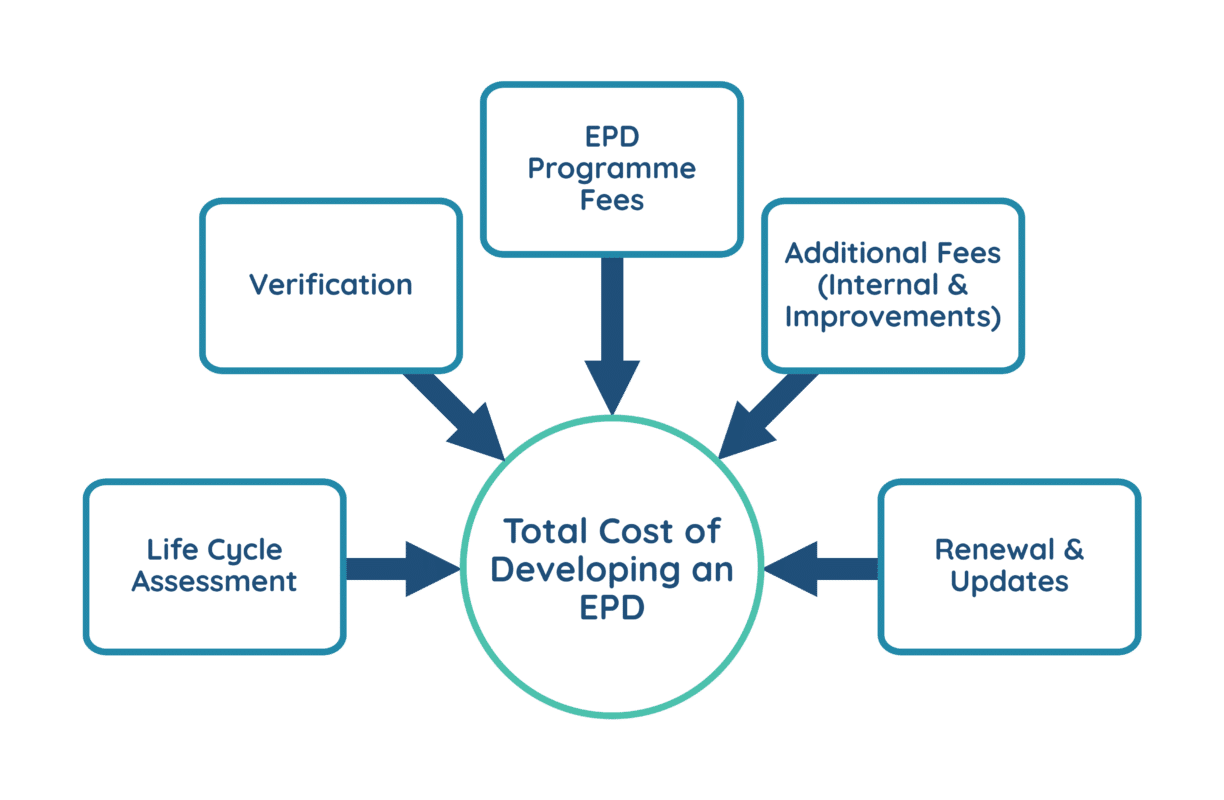
We’ve broken down the main cost areas, supported by market data, and outlined what typically influences the total price of developing, verifying, and publishing a ‘typical’ EPD, including:
- Life Cycle Assessment Costs
- Verification Costs
- EPD Programme Fees
- Additional Internal Costs
- EPD Renewal & Updates Costs
Life Cycle Assessment (LCA) Costs
The life cycle assessment is usually the costliest step in the process, covering data collection, assessment of the full life cycle of the product, and modelling of all relevant impacts.
An international survey of 15 EPD Programmes (‘International Survey of the Costs of Assessment for Environmental Product Declarations’, Tomohiro Tasaki et al.) found that the workload for LCA and EPD preparation is typically between 5 and 20 person days, with a median of 15 person days. Adjusting the study’s 2014 median cost to 2026 US dollars using the Bureau of Labor Statistics (BLS) Consumer Price Index (CPI) calculator gives $20,849[1].
According to a 2024 study of construction product EPDs in Denmark (‘How Much is the Cost of Environmental Product Declaration for Construction products? Experiences from Denmark‘, Shobatake K. et al), the median consultancy cost was $24,037, with a range of $18,873 to $32,585[2] for EPD creation and life cycle assessment. This covers external consultancy work but does not include internal staff time. The study also notes that more complex products and supply chains may increase these costs, while simpler products or product families may reduce them.
There are a few important points to keep in mind:
- We feel that many organisations today may find the process faster due to better software, more experienced consultants, and improved
- Costs change depending on how simple or complex a product is, and whether a single product or a family of similar products can be assessed together
- Workload figures are more consistent than cost figures, so person days are often a better planning benchmark
For organisations producing several EPDs at once, the cost per EPD typically drops because data collection and modelling can be shared across products.
Verification Costs
Verification is a required step in an ISO 14025 aligned EPD process and is carried out by an approved independent verifier. Costs vary between programmes and between product types.
The Tasaki et al. 2017 study found that verification typically takes a median of 3.8 person days, with a range from 2.4 to 6 person days.
According to the Shobatake K. et al. 2024 study, verification costs may vary from $1,965 to $3,537, with a median of $2,866[3] for construction products.
Market data from 2026 also shows increasing verifier fees across Europe due to rising costs of external review work and limited pools of qualified verifiers. These increases often fall in the range of roughly 10-20%, depending on the starting point.
Verification costs also depend on the complexity of the product, as well as programme requirements, number of sites involved, level of completeness and clarity in the submitted LCA, and whether the EPD covers a single product or a product family. Submitting a well organised, complete LCA can help reduce the time required for verification.
The Circular Ecology Programme does not set fixed verification fees. Instead, verifiers quote directly so they can make sure the verification process has adequate resources for the level of complexity of the EPD.
EPD Programme
EPD programme fees can be structured in many different ways. Common types of these fees include:
- Registration fees
- Annual fees or membership fees
- Publication fees per EPD
- Fees for updates or amendments
Because programmes use very different fee structures, it can be difficult to estimate total costs without reading the details carefully.
Research across several EPD Programmes shows that fees for publishing a single EPD over a 5 year period can be between $2,000 and $5,500[4], depending on the size of the organisation and the structure of the programme’s fee system, with higher fees often stemming from EPD programmes that charge an annual membership fee that accumulates over the 5 year period. Larger organisations generally pay more, while some programmes offer much lower fees for smaller companies.
Publishing multiple EPDs together results in substantial economies of scale, reducing the average cost per EPD.
The Circular Ecology EPD Programme Fees have been set at the lower end of the typical ranges stated above.
Additional Internal Costs
The process of producing an EPD also includes internal work that organisations must account for. These costs are not included in external consultancy fees. Internal workload is not included in the Tasaki et al. 2017 study results, but can be notable in practice, especially for organisations new to EPDs.
Internal tasks may include:
- Data collection from production sites
- Supplier engagement to collect upstream information
- Internal review of data and assumptions
- Time spent coordinating with consultants and verifiers
Some organisations may also choose to invest in improvements based on EPD findings, such as energy monitoring or supply chain optimisation, which may reduce future EPD costs, although these are optional and project specific.
EPD Renewal and Update Costs
The EPD remains applicable throughout the 5 year validity period, provided the underlying product and manufacturing processes have not changed in a way that would significantly alter the results. EN 15804+A2 explains that an update is encouraged when changes to the product or its data lead to a difference of around 10% or more in any declared indicator. Updates may also be triggered by changes to the production process, material composition, or the relevant Product Category Rule.
Renewal involves updating the life cycle assessment with new data, revising the EPD document itself, and completing a new independent verification. Programme fees also continue to apply during the new validity period. Renewal is often less costly than creating the original EPD, particularly when the organisation already has clear data systems in place, and only minor changes have occurred since the previous assessment. Programme operators may also allow a smooth renewal process when the structure of the EPD remains largely unchanged.
How Many ‘Person Days’ Does it Take to Produce an EPD?
The Tasaki et al. 2017 study helps explain why workloads vary between projects. The survey reported that LCA and EPD preparation required a median of 15 person days, with a range from 5.4 to 20 person days, and that verification typically required a further 2.4 to 6.0 person days.
Together, the breakdown values suggest that an EPD typically requires around 20 person days of combined modelling and verification work. Projects with straightforward supply chains or multiple similar products often fall toward the lower end of the range, while more complex products, multisite systems or cases requiring extensive data clarification tend to sit toward the upper end.[5]
The chart below shows the average workload distribution of creating an EPD, as detailed in the Tasaki et al. 2017 study:
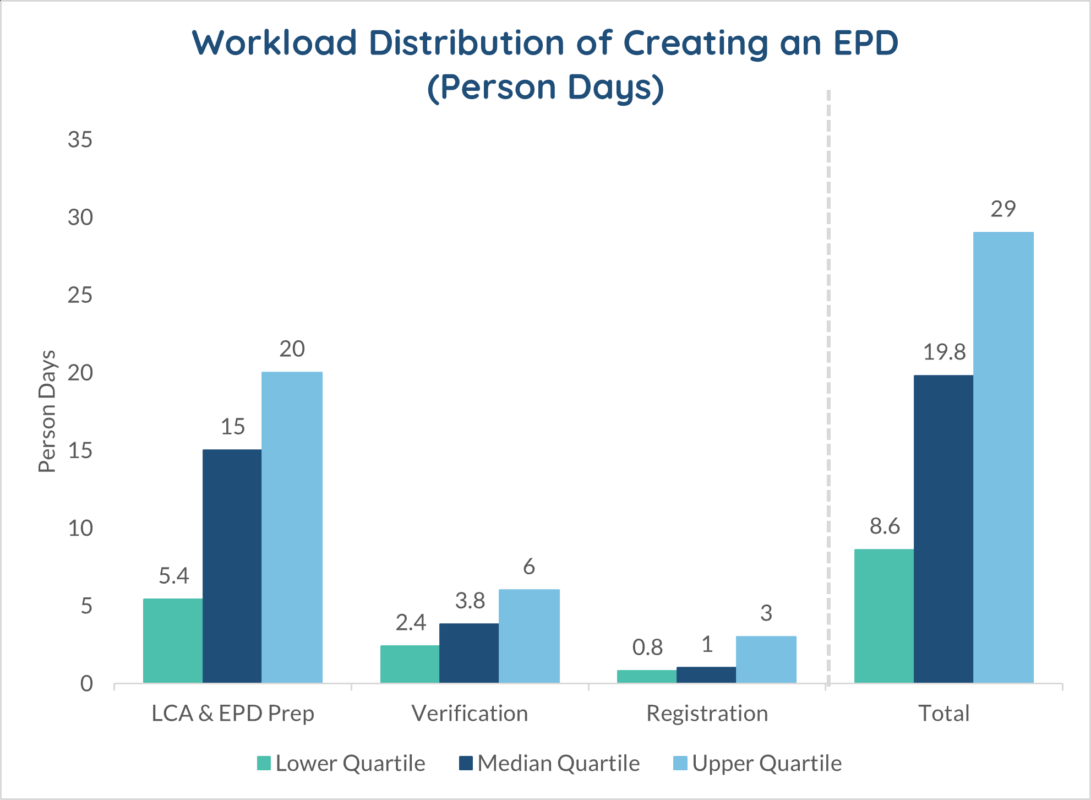
Chart 1: Graph depicting the workload distribution of creating an EPD, in ‘person days’, adapted from the results of the Tasaki et al. 2017 study. Tomohiro Tasaki et al. / Procedia CIRP 61 ( 2017 ) 727 – 731
What is the Total Cost of Producing an EPD?
The total cost of producing an Environmental Product Declaration is shaped by 3 core elements:
LCA and EPD preparation, verification, and programme fees.
The figures below summarise typical or average costs from the following sources:
- International Survey of the Costs of Assessment for Environmental Product Declarations (Tasaki et al. 2017)[6]
- How Much is the Cost of Environmental Product Declaration for Construction products? Experiences from Denmark (Shobatake et al. 2024)[7]
- Circular Ecology research (based on available data for a small pool of EPD Programmes)
Table 1: Typical Costs for a Single EPD
|
Cost |
Typical Range |
Total Range |
Summary |
|
LCA & EPD Preparation |
$11,436-31,097 Tasaki et al. |
$11,436-32,585 |
Figures exclude internal staff time; complexity and data readiness influence variance. |
|
$18,873-32,585 Shobatake et al. 2024 |
|||
|
Verification |
$2,882-4,666 Tasaki et al. 2017 |
$1,965-4,666 |
Higher effort reflects broader scopes or continual corrections, even though calendar lead time can still run to weeks in busy periods. |
|
$1,965-3,537 Shobatake et al. 2024 |
|||
|
Programme fees (for 5 years) |
$2,000-5,500 |
Often $2,000-5,500 (Cautionary note: Your fees could go as high as $24,172 over 5 years in some EPD programmes) |
Varies by EPD programme and size of organisation. Some programmes have an annual fee over 5 years, which adds up. |
|
Total |
$15,401-42,751 |
There are many factors that influence the costs of producing an EPD. These figures are based on the data outlined in this article. |
|
These figures show that most of the cost typically comes from LCA and EPD preparation, with verification representing a smaller part. Programme fees differ between EPD Programmes and were not quantified in the international survey.
In practical terms, a single EPD may result in combined consultancy and verification costs in the region of ~$13,401-37,251, based on the Shobatake et al. 2024 study and 2026 equivalent values to those derived from the Tasaki et al. 2017 survey medians and ranges. Programme fees, although not specified in the Tasaki et al. 2017 survey, add further cost over the 5 year validity period and depend on the specific fee structure of the chosen EPD Programme.
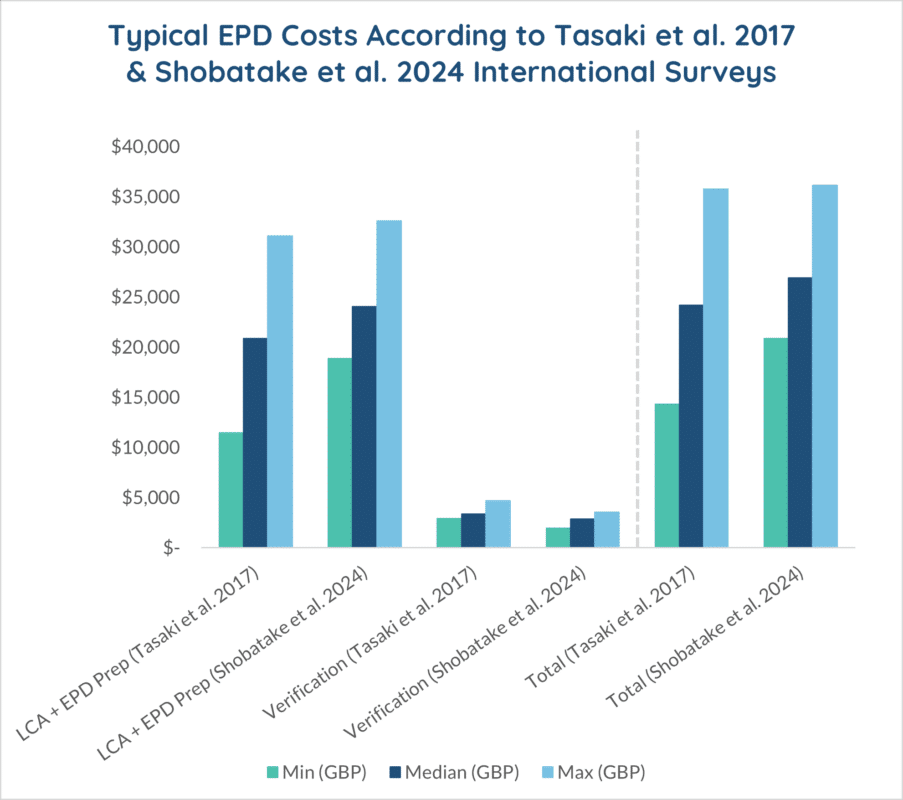
Chart 2: Typical costs associated with the creation of an EPD, in USD, adapted from the results of the Tasaki et al. 2017 and Shobatake et al. 2024 studies.
When multiple EPDs are developed together, efficiencies in data collection and modelling substantially reduce the cost per EPD. This is supported by the wide variation in workloads reported in the survey, which reflects lower marginal effort when similar products or shared datasets are used.
We Can Help Reduce Your EPD Costs
Understanding EPD costs helps organisations plan their approach with more confidence. While the process involves external consultancy, verification, and programme fees, it also provides long term value by improving product transparency and supporting environmental decision making.
There are several practical ways to manage and reduce the total investment. Much of the total cost is influenced by efficiency, preparation, and clarity, rather than the product itself. If your organisation wants to understand how life cycle data can support your sustainability goals, or you are planning to develop EPDs, our team can support you through the next steps with more clarity and efficiency.
The Circular Ecology EPD Programme provides a straightforward route to publishing EPDs, with a focus on quality, independence, and practical support. We welcome organisations looking to develop their first EPD or expand an existing portfolio.
How to Reduce the Cost of Your EPD
There are a number of useful ways to effectively reduce the overall cost of your EPD. Please complete the form below, and we will send you a summary you can use as a checklist for reducing these costs from the outset.
Footnotes
[1] The source study (2014 cost basis) reports a median cost of $15,250 (2014 USD) and a typical workload of 15 person days for LCA and EPD preparation. For GBP context, $15,250 (2014 USD) is approximately £15,671 in 2026.
[2] When converted to GBP, this translates to a £19,550 median for consultancy (LCA & EPD Preparation), with a range of £15,350-£26,500.
[3] When converted to GBP, this translates to a £2,330 median for verification, with a range of £1,600 to £2,880.
[4] Values researched were compiled in GBP, converted to USD using the XE Currency Converter (xe.com/en-gb/currencyconverter).
[5] The Tasaki et al. 2017 survey also asked programme operators to estimate the “total EPD workload”. These totals were reported independently by respondents and were not calculated from the individual task values. As a result, the quartiles for the “total” values do not directly align with the sums of the breakdown rows. In Chart 2, we’ve combined the workload estimates from each stage of the process to provide more reliable totals.
[6] Original Tasaki et al. 2017 survey values were collected in 2014 and reported as $15,250 USD (LCA & EPD preparation) and $2,447 USD (verification). These correspond to £13,450 and £2,160 GBP in 2026, respectively. USD figures have been adjusted using the US Bureau of Labor Statistics (BLS) CPI Inflation Calculator (May 2014 to Jan 2026).
GBP figures have been adjusted using UK cumulative inflation to provide a 2026 equivalent for contextual reference. After adjustment, the median combined consultancy and verification cost would be approximately £15,610.
Actual 2026 costs may vary due to improvements in LCA tools, workflows, and market maturity.
[7] Converting USD values provided in the Shobatake et al. 2024 study to GBP gives £19,550 (LCA & EPD Preparation) and £2,330 (Verification).
Related (EPDs):
Interested in learning more about Environmental Product Declarations? Explore our range of related content:

Circular Ecology Launches IC+, a New Embodied Carbon Database for Professional Use
The launch gives more than 20 years of embodied carbon data development a sustainable foundation [...]
Oct
Understanding the IC+ End User Licence Agreement (EULA): Working with Premium Data
A practical guide to using, sharing and reporting licensed IC+ data As we venture into [...]
Oct
ISO 14060 Consultation Opens as SBTi Releases Corporate Net Zero Standard v2.0
Two major developments this month indicate continued evolution in the global net zero standards landscape, [...]
Jun
DESNZ Release 2026 UK GHG Conversion Factors
The Department for Energy Security and Net Zero has released the 2026 UK Government Greenhouse [...]
Jun