
Science Based Targets – Setting Targets with SBTi
The Paris Agreement, signed in 2015, set out an ambition to limit average global temperature rises to well-below two degrees (WB2D), and ideally to 1.5 degrees (1.5D) compared to pre-industrial levels.
For businesses to align to this ambition, frameworks have been developed to set out target emissions reductions aligned to the latest climate science. One such framework is the Science Based Targets Initiative (known as SBTi).
SBTi utilise a remaining global carbon budget, modelled to the WB2D and 1.5D climate scenarios, and provide organisations with specific reduction targets reflecting its specific base year emissions levels. Commitments can be adopted as near-term targets, with target years set between 5-10 years from the date of adoption, or longer-term targets to be achieved before 2050.
All targets under SBTi must be expressed as absolute (tCO2e) reductions.
Making commitments via the SBTi sets a clear, specific, and verifiable set of goals for your organisation. These formal commitments can moreover guide your reduction journey and differentiate you against competitors and peers.
Who Can Set a Target?
Almost any business* can set an emissions reduction target and seek to have it validated by SBTi, however, the process is different for businesses classed as small and medium-sized enterprises (SMEs) compared to larger organisations.
To be eligible as an SME, the following criteria must be fulfilled:
- Have <10,000 tCO2e across scope 1 and location-based scope 2 emissions
In addition to 3 of the 4 statements below being true:
- Employ <250 employees*
- Turnover of <€50 million*
- Total assets of <€25 million*
- Are not in a mandatory Forest, Land and Agriculture (FLAG) sector
*Businesses in certain sectors, such as fossil fuels industry, are unable to set SBTs.
What are the Steps?
|
Corporate Route |
SME Route |
|
Determine route based on eligibility criteria |
|
|
Make a commitment to setting SBTs |
|
|
Understand and develop your baseline year footprint |
Understand and develop your baseline year footprint |
|
Develop your target in line with criteria |
Develop your target in line with criteria |
|
Submit your target for validation |
Submit your target for validation |
|
Communicate your targets |
Communicate your targets |
|
Disclose your progress against targets |
Disclose your progress against targets |
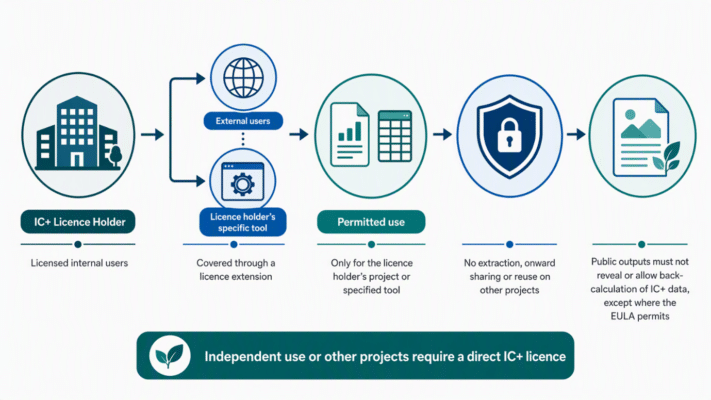
Understanding the IC+ End User Licence Agreement (EULA): Working with Premium Data
A practical guide to using, sharing and reporting licensed IC+ data As we venture into [...]
Oct

ISO 14060 Consultation Opens as SBTi Releases Corporate Net Zero Standard v2.0
Two major developments this month indicate continued evolution in the global net zero standards landscape, [...]
Jun

DESNZ Release 2026 UK GHG Conversion Factors
The Department for Energy Security and Net Zero has released the 2026 UK Government Greenhouse [...]
Jun
EU Publishes Framework for Calculating Whole Life Carbon of Buildings
The European Commission has published a new framework for calculating the life cycle global warming [...]
May
How Does the Process Look?
SBTi services – SBTi recently established a dedicated submission platform to improve the efficiency of processing target submissions. This validation portal is where the full process of target setting takes place.
Baseline – As with any target, you must have something to measure progress against. SBTi require organisations to first select and then report their baseline Scope 1 & 2 carbon emissions, as part of the target setting process. Both calendar year and fiscal year baselines can be used. This baseline must be developed in line with the Greenhouse Gas Protocol (Corporate Standard) and is subject to approval by SBTi. Obtaining a third-party verification of your footprint can speed up the target validation process.
Company details – The portal requires organisations to upload certain supporting evidence of their reported company details, such as total assets, turnover, and headcount. This is commonly through financial statements or corporate reports.
Appropriate target – Organisations can select up to 3 different targets for validation. These are:
- Near-Term targets – fall within 5-10 years of the baseline year.
- Long-Term targets – fall at the latest in 2050, these targets are to become Net Zero, reducing emissions to a residual level
- Net-Zero – True Net-Zero targets may also require the use of carbon removals, to remove the equivalent of all residual emissions. These targets can be set, and realised, before 2050, but must be maintained until 2050, and beyond.
Payment* –A fee is charged by SBTi to cover costs associated with the target validation process. SME organisations pay a flat fee per target, split into two tiers, based on annual turnover. Corporate route targets are variable and should be discussed directly with SBTi Services.
*Fee reductions and waivers are available for companies meeting certain criteria.
Validations
After submitting targets to the SBTi, they undergo a validation process to ensure they align with the latest climate science and SBTi criteria.
This includes checking that the targets are sufficiently ambitious, cover the appropriate emissions (Scopes 1, 2, and 3 where required), and are based on robust and reliable data and methodologies.
SBTi also reviews any supporting evidence to confirm the targets are both achievable and science based. Once approved, the company and its validated targets are listed on the SBTi target dashboard.
If issues are identified, SBTi may provide feedback and allow for revision and subsequent resubmission.
Post-validation commitments
After targets are validated by SBTi, the company is expected to publicly communicate its approved targets within six months and integrate them into its sustainability or corporate strategy.
The company must then annually measure, report, and disclose progress against the targets through its GHG inventory and sustainability reporting. Ongoing engagement and communications with SBTi are not mandatory, however companies are encouraged to maintain transparency and may need to resubmit targets for revalidation if there are significant changes to their structure, emissions profile, or target scope.
For Scope 3 targets, companies are expected to continue measuring and reporting progress across relevant value chain categories, demonstrating efforts to reduce these emissions over time. SME organisations do not require Scope 3 assessment for their baseline target submissions but are required to make a public commitment to commence measurement of their Scope 3 emissions and report these going forward.
Next Steps
Setting targets with SBTi is a clear and universally recognised way of setting trustworthy targets which are aligned with the latest climate science. Circular Ecology can assist companies at all stages of their target setting process, including: