Learn more about how we can help you develop bespoke data collection tools and templates for more accurate carbon reporting below.
The Importance of Supplier Engagement for Carbon Reduction
Many organisations may have already calculated their Scope 1&2 footprint. However, increasing numbers are now looking towards widening their carbon reporting to include Scope 3 emissions, and especially looking to account for any emissions arising from their supply chain.
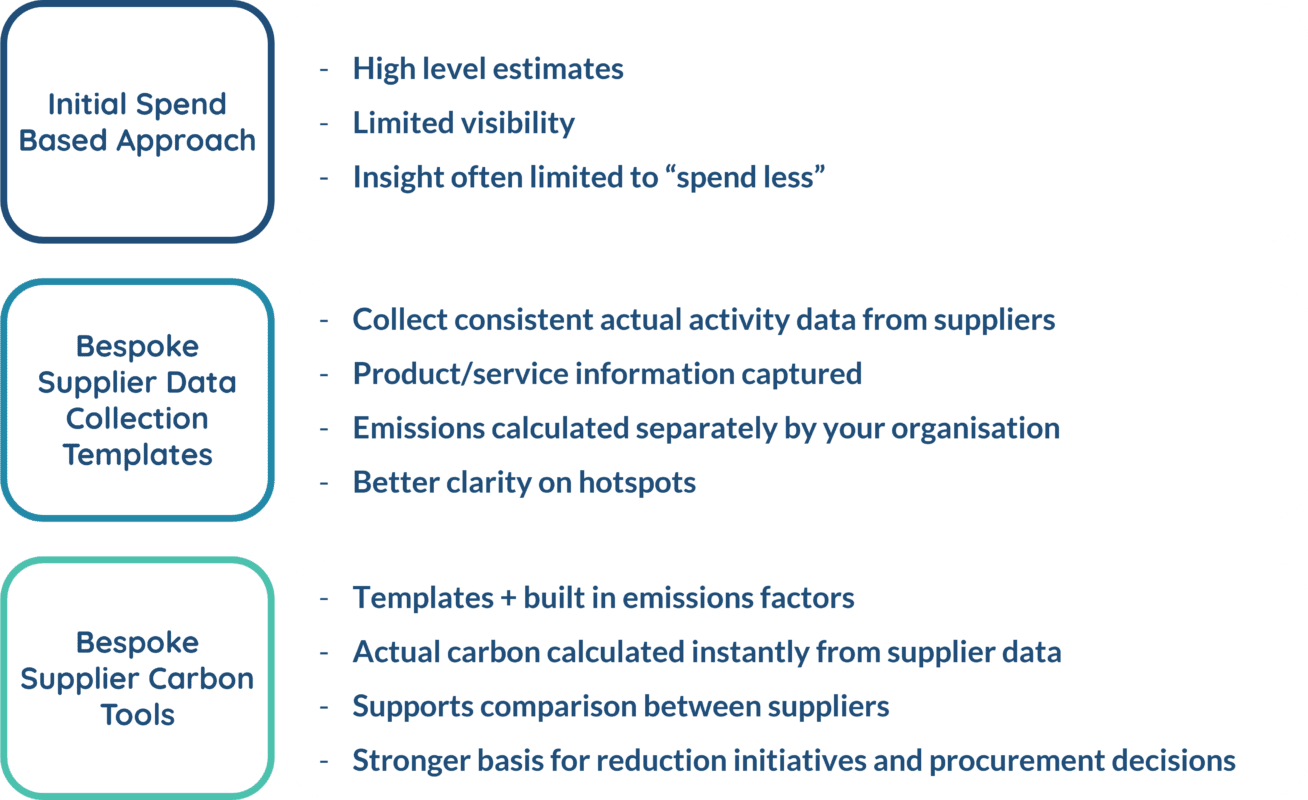
Spend based reporting methods are often used for initial high level Scope 3 assessments. However, when relying on a spend based reporting approach, often the only clear insight into carbon reductions is to spend less.
Therefore, over time, organisations may need to mature their approach to carbon reporting and start collecting actual quantity based (also known as process based) activity data from their supply chain, to allow for better reporting accuracy and to be able to measurably action any carbon reduction strategy.
The process of collecting quantity based activity data from suppliers in a straightforward, consistent, and manageable format can often be difficult.
By establishing your own supplier data collection templates and tools, bespoke for your supply chain, you can gather the specific information you need to improve your Scope 3 data, better visualise the true impacts of your supply chain, and identify real carbon hotspots with greater ease and accuracy.
Increasing the use of quantity based (process based) data will provide you with additional leverage when it comes to actioning carbon reduction initiatives and meeting any Carbon Reduction Targets.
The Role of Templates and Tools for Supplier Engagement
Circular Ecology can support you with the development of bespoke data collection tools and templates, which can drive your supplier engagement and allow you to request and compile the information you need for your carbon reporting.
Supplier Data Collection Templates
A supplier data collection template can be developed to request organisation level data from relevant suppliers. It can be designed to request supplier specific carbon data, where this may already be available, or it can be used to collect other useful key information on the product(s) or service(s) they supply to you, to allow for the calculation of carbon impacts.
Supplier Data Collection templates can, for example, be developed to collect the following types of supplier data (not exhaustive):
- Latest reported supplier Scope 1, 2 and 3 emissions,
- Any Environmental Product Declarations (EPDs) or other carbon disclosures already published for a supplier’s products,
- Constituent material types and compositions of the product supplied,
- Transport distances and methods of materials across a product’s different manufacturing and distribution stages,
- Electricity and fuel consumption from manufacturing, services or events.
The collected data can then be utilised by your organisation, outside of the data collection template, to calculate more accurate carbon impacts specifically related to your supplier’s provided products and services.
The data collection templates allow a user to gather information from a wide range of suppliers in a clear, consistent, and bespoke format, significantly reducing the internal resource required to collate and format disparate data submissions outside of a defined template.
Supplier data collection templates are a quick and efficient starting point to begin the process of qualifying and gathering the data you need for your carbon reporting.
Supplier Data Calculation Tool
Beyond templates, Circular Ecology can also develop further functionality into these structures, transforming them into more automated and highly bespoke calculation tools. These tools can be fully formulated and loaded with the appropriate background emissions factors to allow any data entered by suppliers to be quickly and reliably converted into calculated carbon emissions.
These tools can be developed as highly bespoke to the user and can be configured to calculate emissions from material & product suppliers, service providers, events, or any combination of these.
Any existing emissions factors taken from available datasets, or newly developed bespoke factors, can be incorporated into the tools. For materials, this could include the use of the ICE Database. For energy, fuels and transport, factors could include DESNZ GHG Conversion factors, or equivalent data for other nations or regions. Due to the bespoke nature of these tools, any appropriate set of carbon factors could be incorporated into a tool.
Tools can also be developed to allow suppliers to insert their own relevant and verified carbon factors for materials, fuels, and electricity, where applicable.
Carbon values developed using bespoke tools are the next best available option in situations where EPDs, LCAs or Product Carbon Footprints (which would normally be undertaken by a product or service owner) may not be available. Tool based values are, however, significantly more accurate and relevant than the commonly used spend based approach, and they can help bridge the gap until more specific product based assessments are available.
Tools are not only useful for assisting with the calculation of Scope 3 emissions from your supply chain, but can also allow for useful comparisons between suppliers when it comes to selecting lower carbon products or services.
Comparison of Functionality Between Templates and Tools
| Template |
Tool |
| Supplier data collated in a bespoke, comparative, and consistent format, regardless of the provider |
Covers all the same as a template, with added functionality of calculated carbon outputs |
| Can be aligned to technical standards and requirements |
Pre-loaded with trusted emissions factors, which can be easily maintained and updated |
| Can incorporate data quality frameworks to assess supplier data maturity |
Ability to incorporate custom emissions factors from suppliers where relevant |
What are the Benefits of Using Supplier Templates & Tools?
Supplier Templates and Tools can provide any of the following benefits to your organisation and your carbon reporting:
- Improves accuracy and precision of your Scope 3 carbon data for significant categories such as “Purchased Goods & Services”, “Capital Goods”, and “Upstream/Downstream Transport & Distribution”, amongst others,
- Increases the likelihood of receiving specific data, such as EPDs, for products, providing the most accurate available product level data,
- Better decision-making ability with regard to your most impactful products and services,
- Pinpointing of the biggest carbon hotspots and increased ability to identify actionable carbon reduction initiatives,
- Better visibility of the maturity of your supplier’s data quality and your own carbon reporting,
- Provides a framework for benchmarking and comparing suppliers, which can be incorporated into procurement decisions and leveraged to incentivise improved data quality,
- Increases confidence in your organisational carbon footprint reporting.
Looking to develop your understanding of carbon library development, or seeking related services? Explore our range of related content: