
Understanding the GHG Protocol: A Guide
If your organisation is starting to measure its carbon footprint, you’ll quickly encounter the GHG Protocol, the most widely used standard for greenhouse gas (GHG) accounting worldwide. It’s the foundation for most carbon reporting frameworks and helps organisations understand and manage their emissions.
What is the GHG Protocol?
The Greenhouse Gas (GHG) Protocol is a globally recognised framework for measuring and managing GHG emissions. Developed by the World Resources Institute (WRI) and the World Business Council for Sustainable Development (WBCSD), it standardises how companies account for emissions in their operations and supply chains.
One of the key features of the GHG Protocol is how it categorises emissions into three “scopes”: Scope 1, Scope 2, and Scope 3. Understanding these and their distinctions are essential for any business starting its carbon accounting journey.
Scope 1: Direct GHG Emissions
Scope 1 includes all direct GHG emissions from sources that are owned or controlled by the company.
Categories within Scope 1 include:
- Stationary Combustion:
- Fuels burned on site (e.g. natural gas, diesel, LPG, coal) for heating, power, or process energy.
- Boilers, furnaces, turbines, heaters, and engines.
- Mobile Combustion:
- Emissions from company-owned or controlled vehicles and mobile equipment.
- Includes petrol, diesel, natural gas, or biofuel use in cars, trucks, ships, airplanes, trains and equipment.
- Process Emissions:
- Emissions from chemical or physical processes (other than combustion).
- Examples: cement manufacturing, aluminium smelting, steelmaking, chemical production.
- Fugitive Emissions:
- Intentional or unintentional releases of GHGs from equipment.
- Includes refrigerant leaks (HFCs), methane leaks from pipelines, SF₆ from electrical equipment.
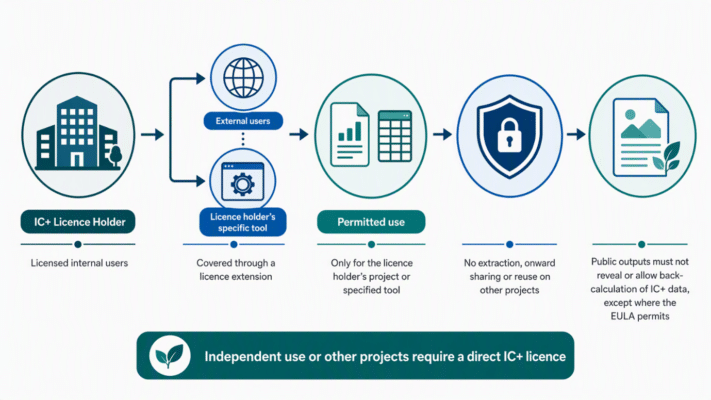
Understanding the IC+ End User Licence Agreement (EULA): Working with Premium Data
A practical guide to using, sharing and reporting licensed IC+ data As we venture into [...]
Oct
ISO 14060 Consultation Opens as SBTi Releases Corporate Net Zero Standard v2.0
Two major developments this month indicate continued evolution in the global net zero standards landscape, [...]
Jun
DESNZ Release 2026 UK GHG Conversion Factors
The Department for Energy Security and Net Zero has released the 2026 UK Government Greenhouse [...]
Jun

EU Publishes Framework for Calculating Whole Life Carbon of Buildings
The European Commission has published a new framework for calculating the life cycle global warming [...]
May
Scope 2: Indirect GHG Emissions from Purchased Energy
Scope 2 includes indirect emissions from the generation of purchased energy consumed by the reporting organisation.
Two main types of purchased energy:
-
Purchased Electricity:
- Emissions from electricity used in buildings, operations, manufacturing, etc.
- Purchased Heating, Cooling, and Steam:
- Includes district heating, purchased chilled water, or steam supplied from an external provider.
There are two available accounting methods to calculate the carbon impact of these activities:
-
Location-based: Reflects the average emissions intensity of the electricity grid in the region the organisation operates.
-
Market-based: Reflects emissions based on supplier-specific data or energy attribute certificates (like RECs or GoOs).
Scope 3: Other Indirect Emissions (Value Chain)
Scope 3 includes all other indirect emissions not covered in Scope 2 that occur in the value chain of the reporting company, both upstream and downstream. There are 15 categories.
Upstream Emissions:
- Purchased Goods and Services:
- Emissions from the production of products and services bought by the company.
- Includes raw materials, packaging, consulting services, software, etc.
- Capital Goods:
- Emissions from the manufacture of capital equipment (buildings, machinery, vehicles, etc.) purchased by the organisation.
- Fuel- and Energy-Related Activities (not included in Scope 1 or 2):
- Emissions from extraction, production and transportation of fuels consumed, commonly known as Well-to-Tank.
- Includes upstream emissions from electricity generation and transmission losses.
- Upstream Transportation and Distribution:
- Transport and distribution of purchased goods (in vehicles not owned by the company).
- Includes inbound logistics, warehousing, and third-party freight.
- Waste Generated in Operations:
- Emissions from third-party transport, disposal or treatment of operational waste (e.g. landfill, composting, incineration, recycling).
- Business Travel:
- Emissions from employee travel via air, rail, bus, taxi, rental car, hotel stays, etc.
- Only for travel paid for by the company but operated by third parties.
- Employee Commuting:
- Emissions from employees travelling to and from work (cars, public transport, cycling if relevant).
- Upstream Leased Assets:
- Emissions from assets leased by the company but owned by others (if not included in Scope 1 or 2).
- E.g. rented office space, vehicles, equipment
Downstream Emissions:
- Downstream Transportation and Distribution:
- Emissions from distribution of sold products in vehicles or facilities not owned/controlled by the company.
- Processing of Sold Products:
- Emissions from processing or transforming intermediate products by third parties.
- Use of Sold Products:
- Emissions from use of products sold to customers (especially relevant for fossil fuels, vehicles, appliances, etc.).
- End-of-Life Treatment of Sold Products:
- Emissions from disposal of products after consumer use (landfilling, recycling, incineration).
- Downstream Leased Assets:
- Emissions from assets owned by the company but leased to others (if not included in Scope 1 or 2).
- Franchises:
- Emissions from franchises not directly owned by the company but operating under its brand.
- Investments:
- GHG emissions from equity or debt investments (relevant for financial institutions, private equity, pension providers).
For many organisations, Scope 3 can account for the vast majority of their carbon footprint. You can see a diagram of the three scope categories below:

Why Undertake an Organisational Carbon Footprint?
Understanding and reporting your emissions is becoming a core part of doing business. Investors, customers, and regulators are increasingly demanding transparency on climate impacts. Getting to grips with Scopes 1, 2, and 3 helps you:
-
Identify your biggest carbon hotspots
-
Set credible reduction targets
-
Respond to ESG reporting requirements
-
Make informed, sustainable business decisions
How to Get Started?
You don’t have to do everything at once. Here’s how many organisations begin:
-
Map your operations to identify emissions sources.
-
Start with Scopes 1 and 2, where data is often more accessible (e.g. energy bills, fuel use).
-
Tackle Scope 3 gradually, focusing first on high-impact areas like purchased goods or travel.
-
Use a trusted standard like the GHG Protocol or a reputable consultant to guide the process.
-
Keep it transparent, document assumptions, and build capacity over time.
- Get verified: Use third-party verification to be sure on the validity of your calculations.
Need Our Help?
Circular Ecology has experience in helping organisations of all sizes measure and manage their carbon footprint. Whether you are just getting started on your footprinting journey, are looking to develop a carbon reduction plan, or get your calculations verified, use the form below to contact us and we’ll be in touch.