EPD Operator Programme - Frequently Asked Questions
Explore answers to Frequently Asked Questions (FAQs) on the Circular Ecology EPD Operator Programme. If your question is not listed here, please feel free to reach out to us directly.
An Environmental Product Declaration (EPD) is a document that can be used internationally to demonstrate the environmental performance or impact of any product or material over its lifetime.
While closely related, these two assessments serve different purposes and are often confused. You can find out more about the key differences between EPDs and Life Cycle Assessments (LCAs), including when each is needed, and how they work together to support environmental transparency and compliance, in our article here.
The Circular Ecology EPD Operator Programme provides verified EPDs across the construction sector and beyond. The programme allows us to publish EPDs as the programme operator. It has been set up in alignment with ISO 14025 on Type III Environmental Declarations. The goal of the EPD programme is to provide high-quality EPDs at a competitive price.
Manufacturers, industry associations, and service providers operating within the construction and building materials sectors are eligible to participate.
EPDs allow organisations to communicate verified environmental performance, meet client or regulatory requirements, and contribute to whole-life carbon and sustainability assessments in construction and beyond.
The Key Documents page hosts the:
- General Programme Instructions (GPI)
- Product Category Rules (PCR)
- EPD Template
- Verification Template
Product Category Rules (PCR) define the rules, requirements, and guidelines for developing EPDs for a specific product category. They ensure comparability and consistency between EPDs within the same category.
Each EPD must be independently verified by an approved verifier to confirm that it meets the programme requirements, Product Category Rules (PCR), and relevant standards.
Verification is carried out by verifiers approved under the Circular Ecology EPD Programme who demonstrate suitable competence and impartiality in line with ISO 14025 requirements.
An EPD is valid for five years from its date of publication unless otherwise specified or if significant product or process changes require earlier revision.
Organisations can contact us to begin the process.
Participation requires adherence to the programme’s GPI, PCR, and verification procedures.
Please visit our About the EPD Programme page for more information.
For a breakdown of the EPD Programme fees, including information on publishing single and multiple EPDs, please visit the dedicated EPD Programme Fees page.
The Circular Ecology EPD Programme aligns with ISO 14025 (Type III environmental declarations) and EN15804+A2 for construction sector EPDs. The underlying LCA work must follow ISO 14040 and ISO 14044.
Yes, provided the LCA complies with the applicable PCR, uses current data, and meets the methodological requirements defined in ISO 14040, ISO 14044, and EN15804+A2.
Data quality is evaluated according to the criteria in the applicable PCR, covering temporal, geographical, and technological representativeness. Verification includes review of data quality documentation.
Yes. Updates can be made if significant product or process changes occur or if new data becomes available. Updated versions must undergo verification before re-publication.
Circular Ecology serves both as the programme operator and secretariat, responsible for administering the programme and approving verifiers.
Once verified and approved, EPDs are published in the Circular Ecology EPD Library with key details including product name, manufacturer, PCR reference, declaration ID, and standard alignment.
Discuss Participation in the EPD Programme
To get started or request further information, please use the form below.
Related (EPDs):
Interested in learning more about Environmental Product Declarations? Explore our range of related content:
Circular Ecology Launches IC+, a New Embodied Carbon Database for Professional Use
The launch gives more than 20 years of embodied carbon data development a sustainable foundation [...]
Oct
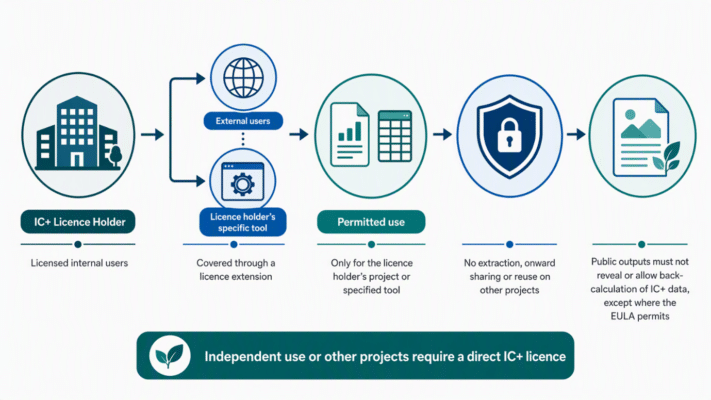
Understanding the IC+ End User Licence Agreement (EULA): Working with Premium Data
A practical guide to using, sharing and reporting licensed IC+ data As we venture into [...]
Oct

ISO 14060 Consultation Opens as SBTi Releases Corporate Net Zero Standard v2.0
Two major developments this month indicate continued evolution in the global net zero standards landscape, [...]
Jun