Carbon reduction claims are becoming increasingly important for organisations looking to demonstrate environmental progress, respond to client requirements and differentiate products in the market.
Claims such as “lower carbon”, “reduced environmental impact” or “more sustainable than the alternative” can be powerful. They can support procurement submissions, strengthen marketing materials and help customers make more informed choices.
However, these claims are also facing greater scrutiny. Customers, regulators, competitors and procurement teams are increasingly asking whether environmental claims can be evidenced, whether the comparison is fair and whether the wording accurately reflects the underlying data.
This is where Product Carbon Footprints (PCFs) and Life Cycle Assessments (LCAs) become important. Used correctly, they provide a structured evidence base for understanding product impacts and communicating reductions responsibly.
Why Comparing Environmental Impacts Is More Difficult Than It Appears
A common misconception is that carbon footprints can be compared in the same way as prices. If one product reports a lower number than another, it can be tempting to conclude that it is automatically the lower-carbon option.
In reality, the number itself is only part of the story. To understand whether a carbon reduction claim is credible, it is necessary to understand how that number was calculated, what was included in the assessment and whether the comparison has been made on a fair and equivalent basis.
This is where many environmental claims become more complex than they first appear. Two carbon footprints may both be based on reasonable data and recognised methods, but still not be suitable for direct comparison. This is particularly common where studies have been prepared for different purposes, by different organisations or using different assumptions.
Some of the main technical challenges include:
- System boundaries: One study may only assess raw materials and manufacturing, while another includes transport, installation, use and end-of-life treatment. A cradle-to-gate result should not be directly compared with a cradle-to-grave result without careful qualification.
- Functional units: Products should be compared on the basis of equivalent performance, not simply equivalent mass or volume. For example, comparing insulation materials per kilogram may be misleading if different quantities are required to achieve the same thermal performance.
- Data quality: One assessment may use detailed primary data from the manufacturer, while another relies on industry averages, secondary datasets or older published information.
- Assumptions and scenarios: Transport distances, electricity mixes, product lifetimes, maintenance requirements and end-of-life routes can all influence the final result.
- Methodology and standards: Different standards, databases or modelling choices can lead to different outcomes, particularly where studies have not been set up specifically for comparison.
These details are not just technical formalities. They determine whether the comparison is meaningful.
A headline claim such as “40% lower carbon footprint” may appear clear and persuasive, but without context it can be difficult for customers, procurement teams or regulators to understand whether the claim is robust. The key question is not simply whether the reported carbon figures are correct, but whether they have been assessed in a consistent, transparent and comparable way.
Using PCFs and LCAs to Support Claims
A Product Carbon Footprint measures the greenhouse gas emissions associated with a product, usually expressed as kg CO₂e per unit. It focuses specifically on climate change impacts and is often a practical starting point for organisations that want to understand the carbon impact of a product, identify hotspots and track reductions over time.
A Life Cycle Assessment takes a broader view. It can assess carbon alongside other environmental impact categories such as water use, resource depletion, acidification, eutrophication and toxicity. This makes an LCA more appropriate where a claim goes beyond carbon and implies wider environmental performance.
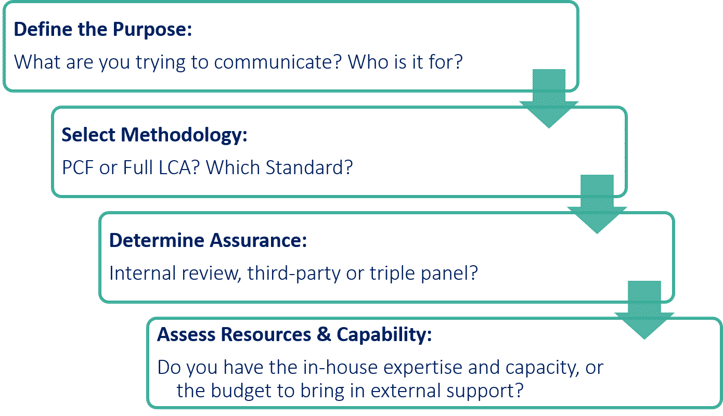
In simple terms, a PCF may be suitable where the claim is specifically about carbon. A full LCA may be needed where the claim is broader, comparative or likely to be used in a public-facing context.
For example, a claim such as “this product has a 20% lower carbon footprint than our previous version” may be supported by a well-scoped PCF, provided the comparison is consistent and transparent.
A claim such as “this product is more sustainable than the market alternative” is much broader. It suggests a wider environmental benefit and may require a full LCA to assess whether carbon reductions are being achieved without increasing other environmental impacts.
The Role of Assurance
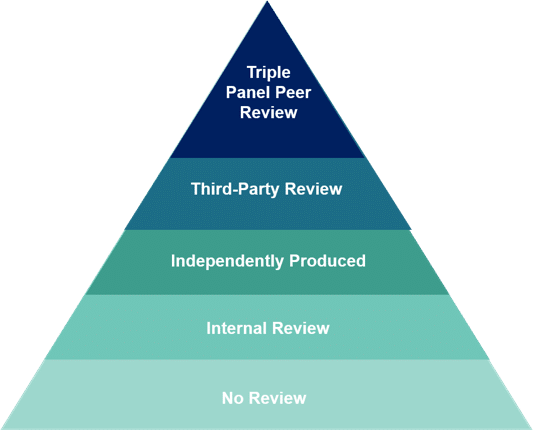
Producing a PCF or LCA does not automatically make a claim credible. The level of review behind the assessment is also important.
A study used only for internal decision-making may require a different level of scrutiny from a study used in marketing, tender submissions or public comparative claims. As the visibility and commercial significance of a claim increases, so does the need for independent review.