
Emissions factors play an important role in any carbon assessment or calculation. Put simply, emissions factors represent the carbon emission intensity associated with a material, product, system, transport method, or fuel against a stated functional unit. This functional unit is often represented in kgCO2e/kg, especially for materials, but other units can include per litre, per m3, or per unit, amongst many more.
Carbon Libraries: Developing Bespoke Emissions Factors
Different types of emissions factors may be more suitable for use during the various stages of a project; for example, generic emissions factors (such as those available from the ICE Database) are likely to be a preferable choice, where the exact material or product details are yet not known, or are still to be determined.
When a particular product selection is unlikely to change, or when undertaking an ‘as built’ assessment, supplier specific emissions factors could then be used. These specific factors can be extracted from verified documents such as Environmental Product Declarations (EPD), Life Cycle Assessments (LCA), or Product Carbon Footprints (PCF). These disclosures will contain information about a specific product or group of products and are representative of that exact product, which has been chosen to be used or installed.
Despite there being approximately 180,000 published EPDs worldwide, this would still only cover a tiny fraction of the available products and materials on the market. Similarly, generic emissions factors would typically be available only for the most common material types.
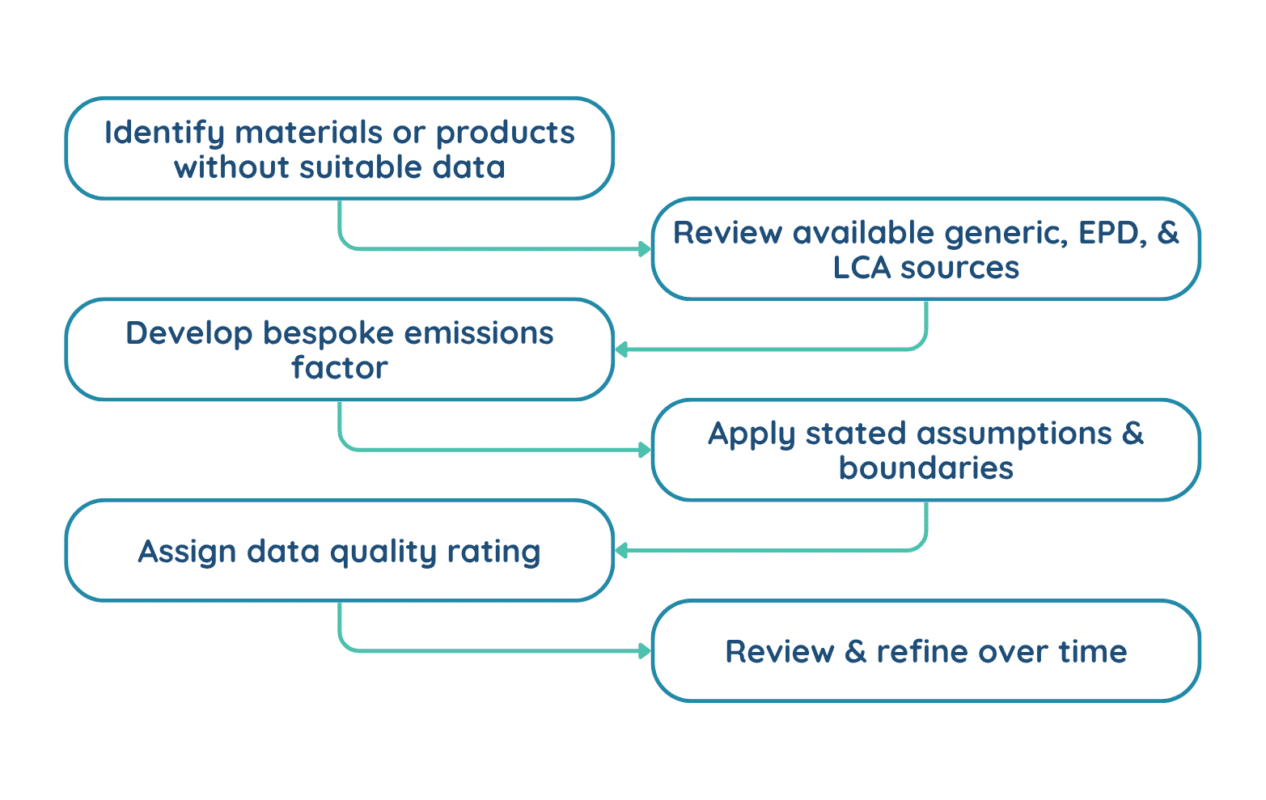
Therefore, in situations where you might be required to measure the impact of materials or products procured from your supply chain, but where specific or generic emissions data is not available or suitable, the development of your own bespoke emissions factors can be a worthwhile approach.
Many organisations may rely on spend based emissions factors in the first instance. However, this route would not provide many meaningful options for effective or informed decarbonisation actions, other than simply “spending less”.
Conversely, producing EPDs, detailed LCAs, or PCFs may not be possible or commercially feasible unless you are the product owner or you are willing to sponsor the product owner to undertake a detailed environmental study.
Bespoke emissions factors can be developed for your specific purposes, using a range of methodologies, which can include:
- Developing generic emissions factors through analysis of available EPD and LCA data
- Using existing generic emissions factors for materials, in combination, based on the proportions of material as part of a product. This can also include additional uplifts for further production or assembly energy, where necessary
Bespoke emissions factors that can be presented within a dedicated carbon library can help an organisation more accurately estimate and measure their carbon impacts, without overreliance on the use of proxies. Bespoke emissions factors can also be developed with an inbuilt data quality index, to illustrate any areas for future improvement, and are always presented with any assumptions and limitations clearly detailed and displayed for the end user.
If you are looking for a solution that fits the gap between spend data and the currently available generic or specific emissions factors, then consider using bespoke emissions factors to assist you on your decarbonisation journey.
Improve the Accuracy & Coverage of Your Whole Life Carbon Modelling with Bespoke Emissions Factors
Please use the form below to contact us if you’re interested in how bespoke emissions factors could be useful for your organisation.
Related (Carbon Libraries):
Looking to develop your understanding of carbon library development, or seeking related services? Explore our range of related content:
- Carbon Estimating & Carbon Library Development
- Bespoke Carbon Library Development for the Built Environment Sector
- Aligning Cost and Carbon
- Supplier Engagement: Data Collection Tools and Templates
- Carbon Libraries: Assessing Impacts of Project Labour
- Carbon Libraries: Modelling Impacts of Site Activities
- Carbon Libraries: Three Point Estimating in Carbon Assessment
- Carbon Libraries: Developing Bespoke Emissions Factors

Circular Ecology Launches IC+, a New Embodied Carbon Database for Professional Use
The launch gives more than 20 years of embodied carbon data development a sustainable foundation [...]
22
Oct
Oct
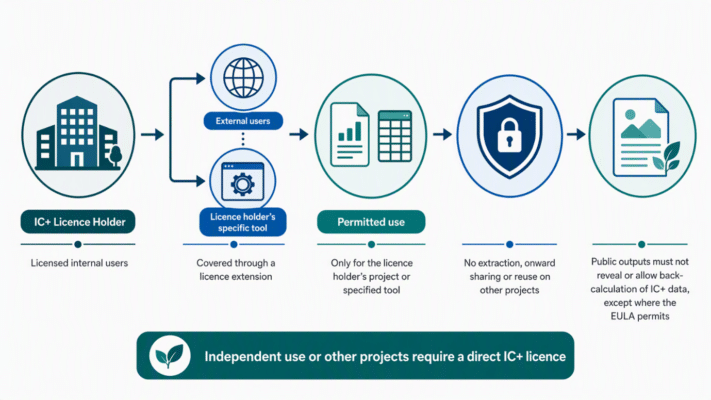
Understanding the IC+ End User Licence Agreement (EULA): Working with Premium Data
A practical guide to using, sharing and reporting licensed IC+ data As we venture into [...]
15
Oct
Oct

ISO 14060 Consultation Opens as SBTi Releases Corporate Net Zero Standard v2.0
Two major developments this month indicate continued evolution in the global net zero standards landscape, [...]
24
Jun
Jun

DESNZ Release 2026 UK GHG Conversion Factors
The Department for Energy Security and Net Zero has released the 2026 UK Government Greenhouse [...]
18
Jun
Jun