
Embodied Carbon - The ICE Database
Embodied carbon comes from the embodied energy consumed to extract, refine, process, transport and fabricate a material or product (including buildings). It is often measured from cradle to (factory) gate, cradle to site (of use), or cradle to grave (end of life). The embodied carbon footprint is therefore the amount of carbon (CO2 or CO2e emissions) to produce a material.
It is a topic of rising importance. In fact, it is normally possible to reduce the embodied energy and carbon of a building or construction project by 10-20% without adding to the build cost. What’s more, embodied carbon is often 20-50%, or so, of the whole life energy and carbon of a building, i.e. when operational carbon emissions are considered.
The embodied carbon life cycle of a building can be expressed on a single diagram, as below.
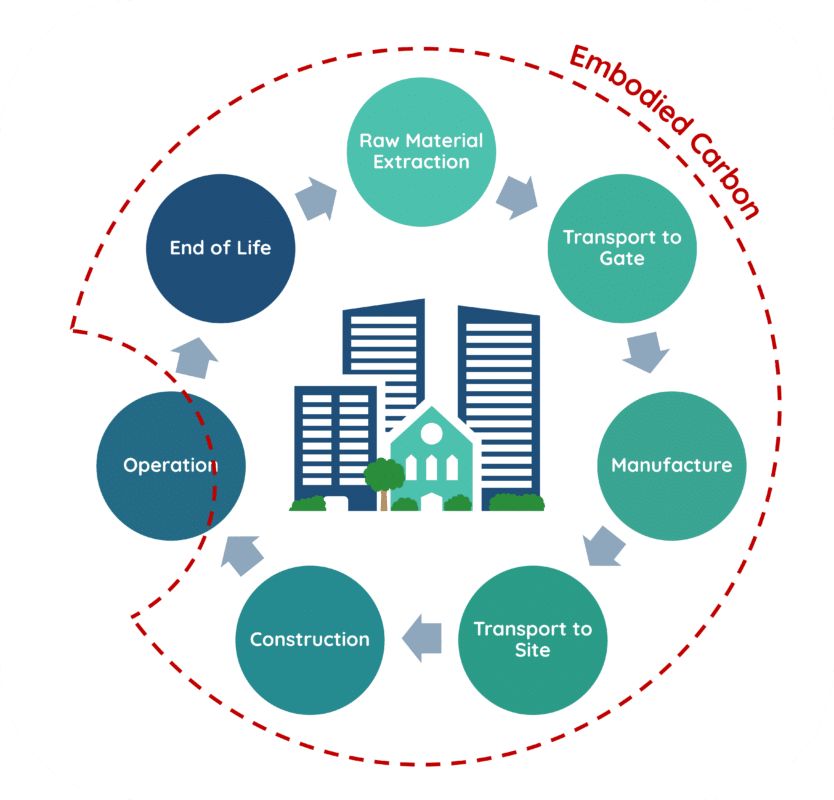
So if you’re not looking at the embodied carbon of your project, then you are missing out on a valuable opportunity. This is where the Inventory of Carbon & Energy database can help. This is where the ICE Database Educational can help. The ICE Database Educational is a free resource designed for educational purposes, providing embodied carbon data for a wide range of construction materials. You can download the ICE Database Educational by completing the form below.
For professional and commercial applications, including use in calculations, tools, software, and reporting, please refer to the IC+ Database.
The ICE Database Educational: Trusted by Over 100,000 Users Worldwide
The ICE Database Educational is a free educational-only resource that can be downloaded by submitting the form below.
It is provided strictly for educational purposes, including:
- Learning and teaching
- Student exercises
- Educational presentations
- Free and paid training courses
- Viewing and browsing the data
The ICE Database Educational must not be used for commercial applications, including project calculations, carbon assessments, tools, software, reporting, or any internal business or consultancy activity.
For these applications, please see IC+.
Please refer to the Terms & Conditions of Use for more information.
ICE Database Educational (ICE Database V5.0, June 2026)
Please complete the form below to access the ICE Database Educational. If you have any issues with the form below displaying, please try from another device or internet network; otherwise, please contact us.
About the ICE Database
The Inventory of Carbon and Energy (ICE) Database is an embodied carbon database of building materials. Dr Craig Jones – founder of Circular Ecology – created the ICE Database in his former role as a researcher at the University of Bath, whilst working for Professor Geoff Hammond at the Sustainable Energy Research Team (SERT).
The ICE Database originally contained embodied energy and embodied carbon factors. However, from 2019, embodied energy factors were no longer included. The data in the wider literature, upon which the ICE Database relies, generally no longer report the embodied energy of construction products. Instead, embodied carbon has become the main metric. Carbon emissions give a better indicator of the contribution of that energy to global warming and climate change.
Overall, the ICE Database has been downloaded by over 100,000 users globally, and it appears in countless reports, journals, books, lectures, embodied energy and carbon footprint calculators, and more.
It contains data for more than 200 materials, broken down into 30+ main material categories, such as:
- Bricks
- Cement
- Concrete
- Glass
- Timber
- Plastics
- Metals
- Minerals and stone
- and many more…
The energy data provides the energy consumed to make a building material. This then gives rise to embodied carbon emissions, contributing to global warming and climate change.
Creating an Embodied Energy and Carbon Database
The ICE Database was created from a large review of the literature. The first version was released in 2005 and has been updated periodically. The diagramme below shows how the database was created.

Looking for Commercial Use?
If you are using embodied carbon data for:
- Project calculations or assessments
- Consultancy or reporting
- Tools, software, or platforms
- Internal business processes or carbon modelling
You will require a licensed dataset.
IC+ is Circular Ecology’s new commercial database, designed for these applications.
Important Update: Use of ICE Data
The ICE Database is an educational-only resource.
Non-educational use of the ICE Database or its underlying data is no longer permitted as of 30th September 2026. Our new, separate commercial database, IC+, provides a licensed route for ongoing professional and commercial use.
Please refer to the Terms & Conditions of Use and IC+ page for more information.
Please also see:
Version Notes
Here you will find details of the version history of the ICE Database. When using the ICE Database, please ensure you reference which version you have used, in line with the Version Log reference below. Check back here in the future to make sure that your version is the most up-to-date.
The latest version of the ICE Database is: ICE Database Educational V5.0 – June 2026
Version Log
| Version | Date Released | Update Summary |
| V5.0 | June 2026 | The ICE Database is now maintained solely as an educational resource. Retains most of the data from ICE V4.1, but with ICE V2.0 data removed due to its age.
Machine-Readable tab removed. Method notes updated. Example references table now included. Various charts/statistical analyses removed from material profiles. Material categories removed from ICE Educational V5.0:
|
| V4.1 | October 2025 | Update to emissions factors used for Bitumen and GGBS. Resultant updates to Asphalt and Concrete material profiles (where impacted by the updates to the Bitumen and GGBS factors).
Update to the Cement, Mortar and Concrete Model. |
| V4.0 | December 2024 | Update to material profiles for:
|
If you have found the ICE Database to be useful in your work or studies, why not connect with us through LinkedIn? Share your project’s story and tag us @CircularEcology.