A credible carbon neutrality claim depends on several factors, from accurate measurement to meaningful emissions reductions and, where emissions remain, the careful and transparent use of offsets.
In this article, we define Carbon Neutrality and explore best practices in achieving it. If your organisation seeks to make carbon claims, respond to procurement requirements, or prepare for greater regulatory scrutiny, this one is for you.
Defining ‘Carbon Neutrality’
Carbon neutrality refers to the concept of mitigating or balancing carbon emissions to a state of neutrality. This can apply to an organisation, product, project, travel, and other activities or entities.
Carbon neutrality is typically achieved through offsetting, although the best practice is to measure and reduce emissions where possible first, then offset residual emissions that otherwise cannot be avoided.
For example, if a company found they were responsible for emitting 1,000 tCO2e (tonnes of carbon dioxide equivalent), they should assess the carbon hotspots and make reductions where suitable. If this results in reductions of 150 tCO2e, the company may then purchase carbon credits to offset the remaining 850 tCO2e, to achieve a state of carbon neutrality.
The scope, calculation method, and time period must be clearly stated. For organisational carbon neutrality, most credible approaches include emissions from operations and purchased energy, and sometimes selected value chain emissions.
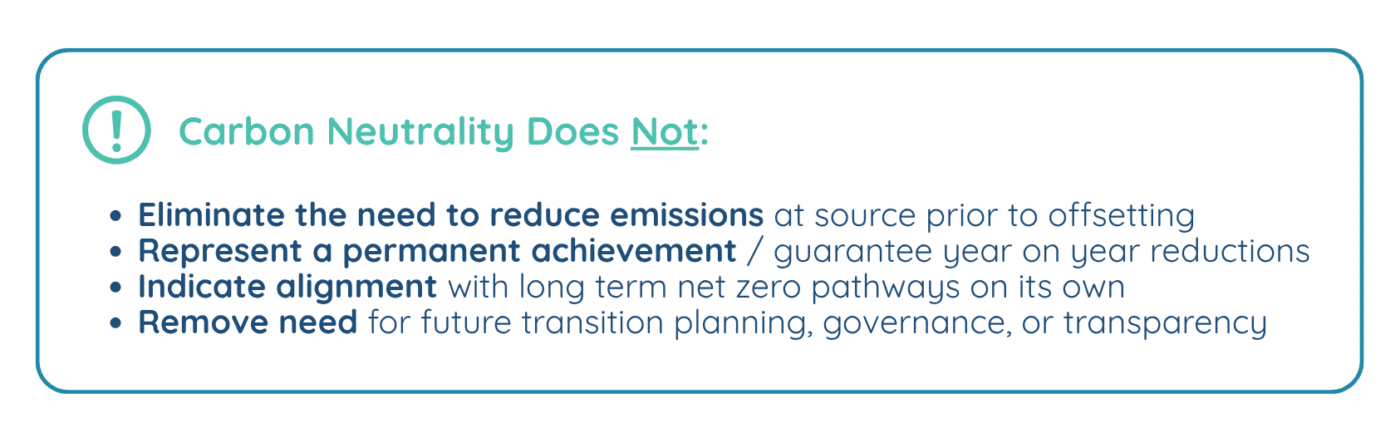
Carbon neutrality also applies to a specific activity, event, or reporting period. It does not guarantee that emissions will continue to fall over time. For that reason, the credibility of a claim depends on the underlying work. Accurate baselines, visible reductions, and transparent handling of remaining emissions determine whether carbon neutrality reflects genuine action or a balancing exercise.
Why Carbon Neutrality Matters Today
Carbon neutrality claims are being examined more closely, and expectations around evidence, scope and transparency have risen accordingly.
Wider expectations around climate related reporting have helped raise the bar for environmental claims more generally. As investors, regulators, and procurement teams expect clearer evidence and more precise disclosures, broad or unqualified carbon neutral statements now face far greater scrutiny than they did previously. This is influencing greater reliance on recognised standards to support clear, defensible claims.
Carbon Neutrality Standards
The first recognised standard was PAS 2060, developed by the British Standards Institution (BSI). PAS 2060 provided a structured method for demonstrating carbon neutrality across organisations, products, services, events, and buildings. It required emissions measurement, the application of reduction actions, and the offsetting of remaining emissions within a defined reporting period, supported by public documentation.
While PAS 2060 made an important contribution by introducing a structured and transparent approach to carbon neutrality, particularly at a time when few consistent frameworks were available, it left some areas open to interpretation. In particular, it did not define the depth or pace of emissions reductions required, which led to variation in how the standard was applied over time. However, it did require organisations to demonstrate reductions against a defined baseline in order to maintain alignment. The PAS 2060 standard has since been withdrawn and replaced by ISO 14068‑1.
ISO 14068‑1: Climate Change Management — Transition to Net Zero (Part 1: Carbon Neutrality), published in 2023, is the first international standard specifically for carbon neutrality. It builds upon the foundations of PAS 2060 and strengthens requirements around emissions reduction, governance, and transparency. ISO 14068‑1 introduces a clear hierarchy that prioritises emissions reductions and removals before offsetting is used, with offsets limited to residual emissions that cannot reasonably be eliminated. Since PAS 2060 was withdrawn, ISO 14068‑1 has become the best practice for credible carbon neutral claims.
Both standards rely on established greenhouse gas accounting methodologies, typically including ISO 14064‑1 for organisational footprints, ISO 14067 for product footprints, and the GHG Protocol.
Offsetting Residual Emissions
Even with a clear reduction pathway, most organisations are left with some emissions that cannot be eliminated in the short term. These residual emissions can be addressed through carbon offsetting, but only once reasonable reduction options have been applied.
Offsetting should support, not replace, emissions reduction. Projects should be independently verified, clearly additional, and transparent about how emissions reductions or removals are achieved. Increasingly, scrutiny also focuses on governance, permanence, and long-term monitoring.
In practice, this means using credits issued under recognised verification programmes. Schemes such as the Verified Carbon Standard (VCS), Gold Standard, Climate Action Reserve and others apply defined methodologies, third party validation and ongoing monitoring requirements. These frameworks provide a level of consistency in how projects are assessed and how credits are issued, although they still vary in scope and approach.
Selecting offsets within these systems does not remove the need for scrutiny, but it helps establish a minimum level of quality and transparency. For organisations using offsets as part of a carbon neutrality claim, alignment with recognised programmes is essential.
Carbon Neutrality vs. Net Zero
Carbon neutrality and net zero are terms that should not be used interchangeably, as they describe different types of climate commitment. The distinction matters because expectations around scope, time horizon, and credibility are not the same.
Carbon neutrality describes a balance achieved for a specific activity, event, or defined reporting period. Emissions are measured, reduced where possible, and any remaining emissions are addressed through offsetting.
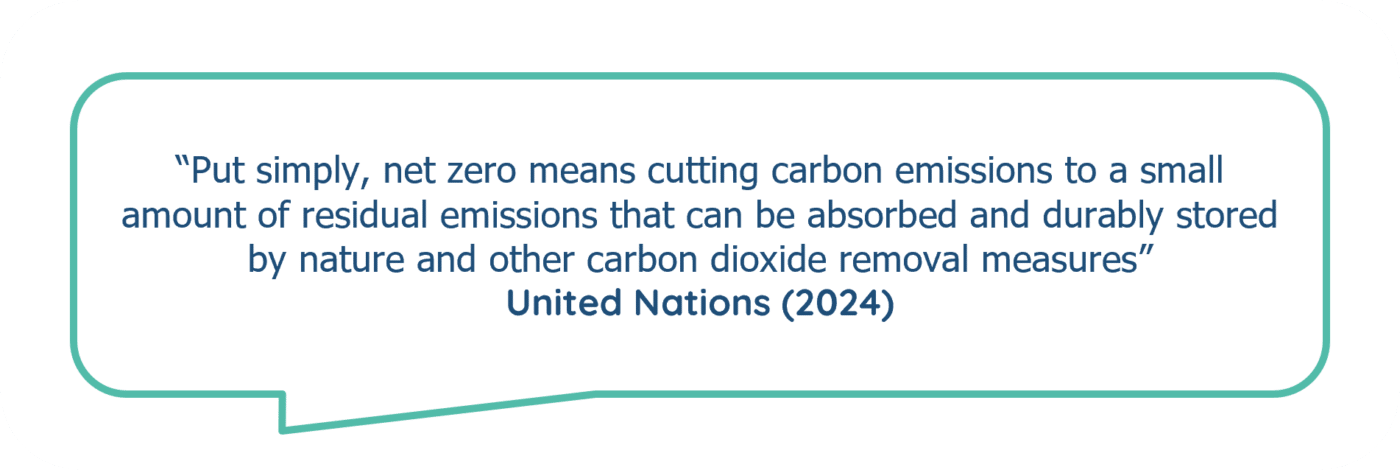
Net zero describes a long-term transition. The focus is on deep and sustained reductions over time, with only a small share of truly residual emissions addressed through removals.
As the United Nations describes it:
Table 1: Carbon Neutrality vs Net Zero
|
Carbon Neutrality
|
Net Zero
|
|
Applies to a defined reporting period, often a single year
|
Applies to the long term, aligned with climate science
|
|
Balance is achieved within the period after reductions
|
Deep, sustained emissions reductions define success
|
|
Reductions are expected but not prescribed in depth
|
Reductions are central and must be science aligned
|
|
Offsetting used to address remaining emissions
|
Neutralisation limited to truly residual emissions
|
|
Often covers selected scopes
|
Expects full value chain coverage where emissions are material
|
|
Commonly applied to products, projects, or services
|
Primarily applied at the organisational or value chain level
|
|
Can be achieved without a long-term reduction pathway
|
Requires a defined reduction pathway and governance
|
Carbon neutrality can play a useful role when it is treated as an interim step. It helps organisations build emissions inventories, test reduction measures, and establish governance. Net zero builds on that foundation, demanding structural change rather than annual balancing.
Verification & Claims
Verification plays an important role in supporting credible carbon neutrality claims. Independent review helps confirm that emissions have been calculated consistently, reductions have been applied as stated, and offsets have been used in line with the chosen approach.
While verification is not technically required in all cases, expectations are rising. Regulators, investors, and procurement teams increasingly view third-party assurance as evidence that a claim is supported by robust data and governance. Where verification is absent, organisations are typically expected to provide a higher level of transparency and explanation.
Carbon neutral claims must be clearly defined. For example, when claiming carbon neutrality for an organisational carbon footprint, statements should specify the reporting period, organisational boundary, and the emissions included, alongside a brief explanation of how reductions were achieved and how remaining emissions were addressed. Broad or unqualified claims are far more likely to be challenged than the more precise, well scoped ones.
Verification does not guarantee perfection, but it reduces risk. It helps organisations spot errors early, improves consistency year to year and provides confidence that public statements reflect the underlying work. We can support those seeking to make credible claims with verification by reviewing the data, methods, and disclosures to help you demonstrate accuracy, reliability, and full alignment with recognised standards. Find out more:
Circular Ecology Verification Services
Common Pitfalls
Even where organisations intend to act in good faith, carbon neutrality efforts often fall short due to a small number of recurring issues.
- Treating carbon neutrality as a one-time achievement
Claims may be made for a single reporting period without a clear plan for how emissions will be reduced in future years. This limits the long-term value and can create expectations that are difficult to maintain. A more credible approach is to pair carbon neutrality with a defined carbon reduction pathway, showing how emissions will continue to fall over time rather than relying on repeated offsetting.
- Unclear or changing boundaries
Claims frequently fail to clearly state what emissions are included and why. Changes in organisational scope or included emission sources between reporting periods make progress difficult to track and comparisons unreliable. This can be addressed by defining boundaries explicitly at the outset and maintaining consistency over time, with any changes clearly disclosed and explained.
- Weak or incomplete baseline data
Missing emission sources, heavy reliance on estimates, or inconsistent data collection can undermine the entire claim. Data published by CDP in 2023 shows that just 41% of companies fully quantify key value chain emissions, despite these often representing the largest share of impact.
- Vague or unqualified public claims
Broad statements such as “carbon neutral” without a reporting period, boundary, or method are challenged more often. Regulators in the UK, EU, and US have all demonstrated closer scrutiny of claims that lack supporting detail.
- Overlooking Scope 3 emissions
Analysis by CDP and BCG shows that supply chain emissions, despite often being 26x higher than their operational emissions, are still commonly overlooked while attention focuses on easier offsetting decisions.
The Journey from Carbon Neutral to Net Zero
Carbon neutrality is best understood as a point on a longer journey, not the destination itself. It provides a snapshot view of how emissions are being managed over a defined period, but it does not by itself describe how those emissions will change over time.
For many organisations, carbon neutrality is the stage at which systems are put in place. Emissions are measured consistently, reduction actions begin to take effect, and governance starts to mature. This work creates the foundation needed for longer-term targets, including net zero commitments that require sustained reductions across operations and value chains.
Net zero builds on this foundation by shifting the emphasis from annual balance to long-term transformation. It requires emissions to fall year on year, with only a small share of truly residual emissions addressed through neutralisation. The discipline developed through carbon neutrality, when applied well, makes this transition more achievable.
Next Steps
If you are exploring carbon neutrality, reviewing an existing claim, or planning how it fits into a wider climate strategy, clarity at the outset makes a material difference.
At Circular Ecology, we support organisations with emissions measurement, reduction planning, offsetting and verification, ensuring that carbon neutrality claims are accurate, transparent, and aligned with recognised good practice.
If you would like to discuss how carbon neutrality applies to your organisation, or how it can support a longer term transition toward net zero, we are happy to help.