Blog, Carbon Neutral, Events, Knowledge Article, Life Cycle Assessment, News, Sustainability, Training Courses
The Vital Role of Environmental Education
Jan
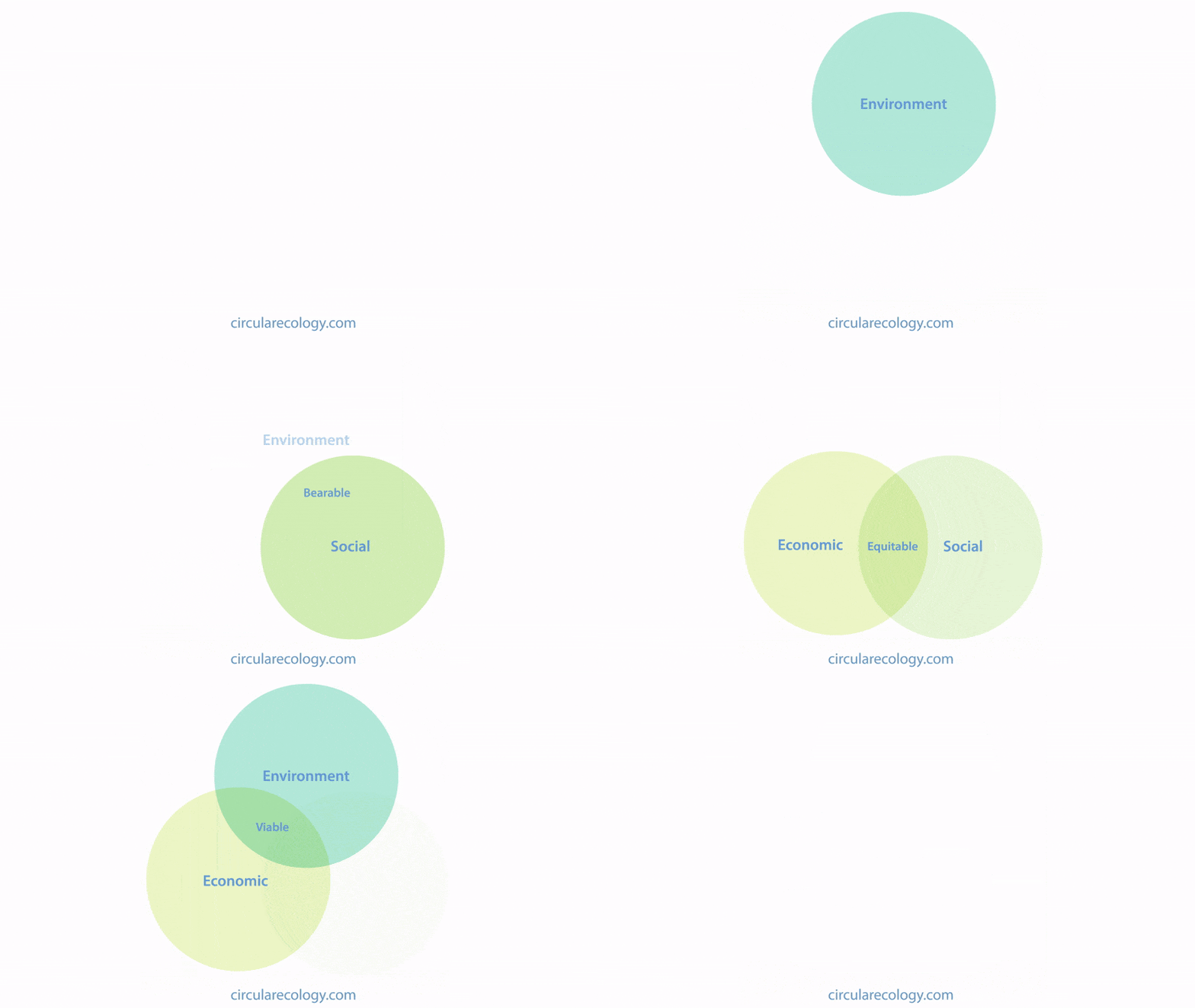
Environmental challenges are seldom isolated issues; they often sit at the centre of the three pillars of sustainability (Environmental, Social, Economic). Expectations around environmental performance continue to rise around the world, and so education plays a central role in helping both organisations and individuals understand impacts, interpret data and insights, and make more informed decisions.
Rather than focusing on awareness alone, environmental education also supports more practical action. This could be in the form of measuring carbon emissions, understanding supply chains, navigating reporting requirements, identifying routes to carbon reduction, community greening projects, and place-based decarbonisation projects.
The Three Pillars of Sustainability
Sustainability can be described through three interconnected pillars: Environmental, Social, and Economic. Together, they provide a useful basis for understanding how environmental decisions affect the planet, people, and prosperity.
We explored this in our Sustainability and Sustainable Development article – progress depends on balancing all three of these pillars in harmony, with environmental education playing a key part in connecting them all in practice.
While these three pillars give us a useful foundation for understanding sustainability, they’re often expressed today through the widely recognised United Nations Sustainable Development Goals (UN SDGs). The 17 SDGs build on the three pillars by corresponding them into a practical global framework that connects education, climate action, health, inequality, and sustainable development.
Environmental
Understanding Impacts on the Planet
The environmental pillar of sustainability focuses on protecting the world’s natural systems, reducing emissions, and managing resources (including water, land, materials, etc.) responsibly.
Climate change, biodiversity loss, and pollution continue to be prominent global challenges. In particular, the built environment is a notable contributor to many of these impacts.
According to the UNEP ‘Building Materials And The Climate: Constructing A New Future’ report from 2023, globally, buildings and infrastructure together account for around 37% of energy related carbon dioxide equivalent emissions. That’s not only through operational energy use, but also the materials and construction processes used, and end of life treatment. This makes the sector one of the largest single contributors to the climate crisis.
Beyond buildings and infrastructure, the transport sector is responsible for around a quarter of global energy related GHG emissions, comprising emissions from road vehicles, aviation, and shipping, and making it one of the largest non-energy sectors after power generation and industry, according to the International Energy Agency (IEA).
Environmental education helps to address this by promoting life cycle thinking.
Understanding the impacts across the full life cycle of products and assets (from raw material extraction to manufacture, use, and disposal) allows for more substantial comparisons between options and helps avoid shifting the burden.
For example, decisions made to reduce operational emissions may unintentionally increase embodied impacts elsewhere if life cycle effects are not considered.
Developing the skills needed to properly interpret environmental data, emissions factors, and assessment outputs is therefore pivotal to improving environmental outcomes in practice.
Economic
Skills, Risk, and Value in the Long Term
Regulatory requirements, investor expectations, and customer scrutiny continue to drive demand for more robust environmental data and disclosures.
Sustainability reporting has expanded rapidly in recent years, alongside growing expectations around carbon accounting, value chain emissions, and transparency.
At the same time, skills gaps persist.
For example, LinkedIn’s Global Green Skills Report 2025 shows that green hiring is growing almost twice as fast as the share of workers with green skills (7.7% vs. 4.3%), making sustainability one of the few areas where demand continues to accelerate even as hiring slows in many other sectors (especially for graduates), and indicates a widening mismatch between demand and capability across most major economies.
Many organisations report challenges in accessing the expertise needed to measure emissions accurately, interpret Life Cycle Assessment (LCA) results and sustainability or carbon reduction strategies, or respond confidently to reporting frameworks, standards, and methodologies.
Environmental education can help to close these skills gaps by building the internal capability needed, reducing reliance on assumptions, and improving the quality of decision-making. The same report shows Sustainability Education among the fastest growing green skill categories globally (+6.7% year-on-year), underpinning broader recognition that organisations need environmental literacy embedded across the workforce.
From a purely economic perspective, a better understanding of environmental impacts can also support long term value creation. Clearer data means organisations can identify inefficiencies, manage regulatory compliance, and plan more successful sustainability strategies in a rapidly evolving policy/market landscape. Workers with green skills are already being rewarded by the market, with a global hiring rate 46.6% higher than the workforce average, which goes to show that environmental capability is translating directly into economic advantage.
Social
People, Transparency, and Trust
The social pillar of sustainability is reflective of how environmental decisions and changes affect people, including workers, communities, and end users.
Transparent and dependable environmental information plays an important role in building trust, whether that’s within organisations, across supply chains, or with the wider general public.
Yet there’s evidence indicating that trust in institutional communication is fragile. In OECD countries, fewer than four in ten people (39%) report trust in their national government, and only 37% believe their government effectively balances current and future interests, which would suggest broader challenges around credibility and public engagement around societal issues – including sustainability initiatives.
Environmental education supports this by improving both consistency and clarity. When teams share a common understanding of terminology, methodologies, and data limitations, it becomes easier for them to collaborate, and therefore, communication becomes more reliable.
This is particularly paramount as social sustainability reporting still lags behind environmental reporting: according to a 2025 analysis, while many companies present environmental targets with measurable indicators, only about 47% do the same for social sustainability, despite 88% of stakeholders valuing social data as highly as environmental data.
Accessible education also supports more widespread engagement, helping non-specialists understand why certain decisions are made and how environmental impacts are assessed.
Importantly, social sustainability also taps into wider societal expectations, with research (Social Preferences Towards the Environment: Assessing and Quantifying Public Support for Sustainable Development, Liashenko et al) showing that over half of people prioritise environmental protection even when it involves trade-offs with economic growth. This reflects a public willingness to accept focused sustainability action when backed by credible information and participation.
Environmental Education Ties it All Together
As we’ve touched on before, the three pillars of sustainability are very closely connected, with progress in one area depending on understanding the others. Gaps in knowledge can weaken outcomes across all three pillars.
Environmental education equips us with a common foundation, supporting consistent approaches, comparable data, and improved decision-making based on clearer evidence.
It’s important to note that sustainability knowledge is not static. It’s constantly evolving: methods are advancing, standards are updating, and expectations are changing over time. Ongoing learning, therefore, is fundamental. Especially in areas like carbon accounting, life cycle assessment, and environmental reporting.
Access to reliable and current information is a core foundation for effective environmental education, with resources like technical guidance and webinars to help professionals deepen their understanding and stay aligned with best practices.
Here at Circular Ecology, we support learning through a range of resources, including our knowledge base, free on-demand webinars, and sustainability eLearning courses – designed to support practical understanding of topics such as Embodied Carbon, Life Cycle Assessment, and Carbon Footprinting.
We have also been developing a more general eLearning course, Sustainability 101, which will introduce the foundations of sustainability, from its historical context and ESG and CSR frameworks to wider environmental challenges, supported by practical case studies.
For those interested in structured learning, our eLearning courses are currently available via our online store at a reduced rate (limited time only – updated January 2026).
Ultimately, sustainability progress relies not only on targets and policies, but also on the knowledge that forms the basis for everyday decisions. World Environmental Education Day, celebrated every January 26th, is an annual reminder that informed people are central to delivering that harmonic balance between environmental, social, and economic outcomes to achieve true sustainability.
